

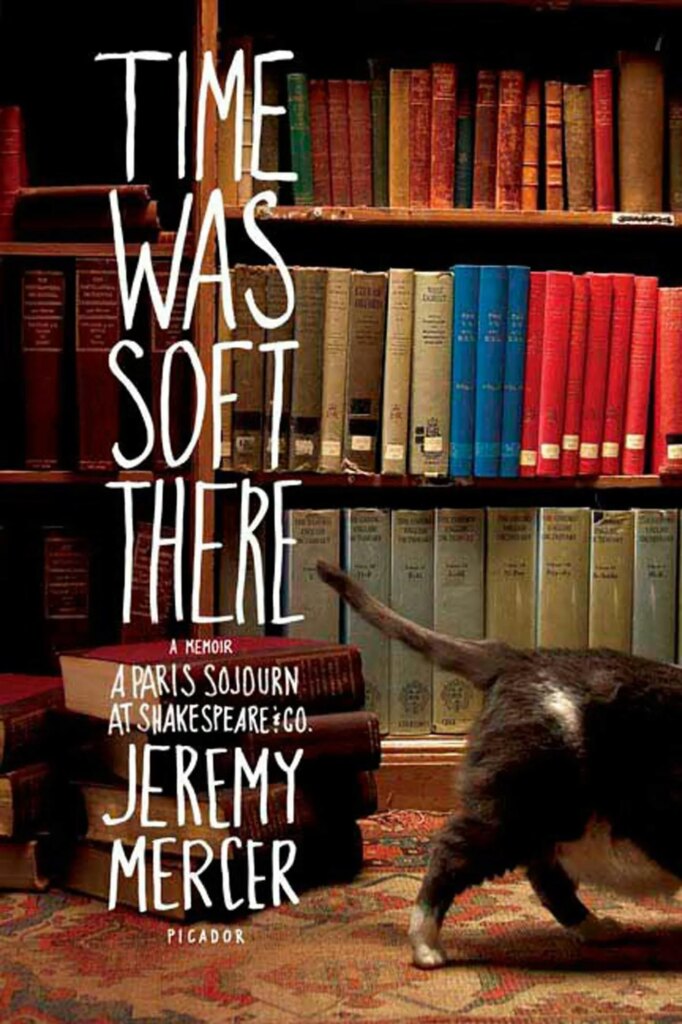
Time Was Soft There

Time Was Soft There

In a small square on the left bank of the Seine, the door to a green-fronted bookshop beckoned….

With gangsters on his tail and his meager savings in hand, crime reporter Jeremy Mercer fled Canada in 1999 and ended up in Paris. Broke and almost homeless, he found himself invited to a tea party amongst the riffraff of the timeless Left Bank fantasy known as Shakespeare & Co. In its present incarnation, Shakespeare & Co. has become a destination for writers and readers the world over, trying to reclaim the lost world of literary Paris in the 1920s. Having been inspired by Sylvia Beach’s original store, the present owner, George Whitman, invites writers who are down and out in Paris to live and dream amid the bookshelves in return for work. Jeremy Mercer tumbled into this literary rabbit hole and found a life of camaraderie with the other eccentric residents, and became, for a time, George Whitman’s confidante and right-hand man.

Time Was Soft There is one of the great stories of bohemian Paris and recalls the work of many writers who were bewitched by the City of Light in their youth. Jeremy’s comrades include Simon, the eccentric British poet who refuses to give up his bed in the antiquarian book room, beautiful blonde Pia, who contributes the elegant spirit of Parisian couture to the store, the handsome American Kurt, who flirts with beautiful women looking for copies of Tropic of Cancer, and George himself, the man who holds the key to it all. As Time Was Soft There winds in and around the streets of Paris, the staff fall in and out of love, straighten bookshelves, host tea parties, drink in the more down-at-the-heels cafés, sell a few books, and help George find a way to keep his endangered bookstore open. Spend a few days with Jeremy Mercer at 37 Rue de la Bucherie, and discover the bohemian world of Paris that still bustles in the shadow of Notre Dame.
“A great read.”

San Francisco Chronicle

Review by 1000 Libraries

Chronicling Jeremy Mercer’s journey to living in one of the world’s most famous bookstores, Time Was Soft There is a captivating memoir that offers a rare behind-the-scenes look at the legendary Shakespeare & Co. In exchange for a place to sleep among the stacks offered by the eccentric owner, George Whitman, Mercer is simply expected to work in the store.

“In the end, yes, it is a famous bookstore and, yes, it is of no small literary importance. But more than anything, Shakespeare and Company is a refuge, like the church across the river. A place where the owner allows everyone to take what they need and give what they can.”

Mercer’s memoir shines in its portrayal of the diverse and often destitute characters who find refuge in the bookstore. He introduces readers to the community of artists, writers, and drifters who call Shakespeare and Company home, all united by their shared passion for literature and their need for a place to belong. Through his insightful and often humorous descriptions, Mercer brings to life the chaotic, compassionate, and sometimes dysfunctional family that develops within the bookstore’s walls.

Time Was Soft There is more than just a personal story; it’s a love letter to a fading bohemian Paris. Mercer’s writing captures the unique atmosphere of the bookstore, from the scent of old paper to the sounds of doors banging and the lively conversations. He details the unconventional routines and simple pleasures of their lives, from scavenging for food to sharing stories and dreams. While the book touches on the hardships of poverty, it’s ultimately an uplifting story about finding community, purpose, and a new perspective on life in an unexpected place.

“The memoir is much more than an entertaining romp through Parisian literary bohemia at the turn of the millennium. Time Was Soft There will likely be the last firsthand account of an aging legend.”

“The milieu he evokes, while a long way from that of the Lost Generation, has its own charm.”

“Mercer has fashioned a colorful de facto biography of Whitman . . . a tightly written, insightful memoir of Left Bank literary radicalism. A great read, both funny and quietly moving.”

Want book recommendations weekly?
Join the COMMUNITY

Get the best of 1000 Libraries delivered to your inbox weekly