

How can ten sonnets create a hundred thousand billion poems? Discover the clever design behind Raymond Queneau’s infinite poetry collection.
More than sixty years ago, French writer Raymond Queneau published one of the strangest and most ingenious books ever made: a slim volume that quietly claims to contain a hundred thousand billion poems.
It’s been over 60 years since Raymond Queneau unveiled his groundbreaking Cent mille milliards de poèmes (A Hundred Thousand Billion Poems), published in 1961. On the surface, it’s a ten-page book of just ten sonnets, fourteen lines each. The kicker? Thanks to a clever bit of design, those ten poems can be recombined into a hundred thousand billion unique sonnets, making it, by sheer number of possible poems, the largest collection of poetry in the world. Curious how? Read on to find out.
Queneau’s Way with Words
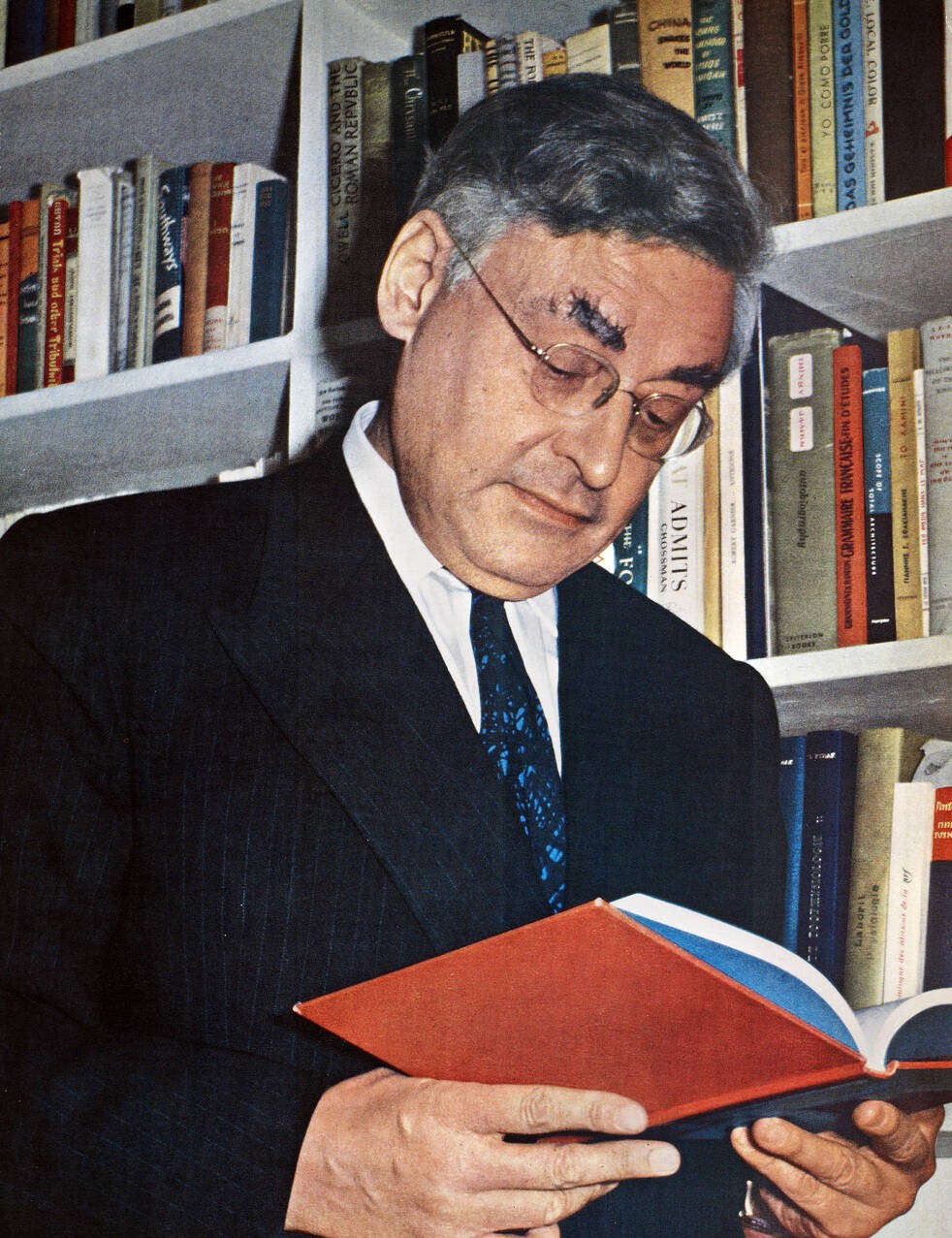
Raymond Queneau was a rare kind of writer: a novelist, poet, and playwright who was also a serious mathematician. That unusual combination is the key to understanding his most famous creation. He is best known today for playful, inventive works like Zazie dans le métro and Exercices de style, and as a co-founder of the Ouvroir de littérature potentielle, or Oulipo, “a workshop of potential literature.”
Founded in 1960 with the mathematician François Le Lionnais, Oulipo brought together French writers and mathematicians to explore what the written word could do under strict structural constraints. Rather than seeing rules as limitations, the Oulipians treated them as engines of creativity, generating entirely new patterns of writing. A Hundred Thousand Billion Poems is often considered the very first work of Oulipo poetry, the movement’s founding masterpiece.
The Surrealists of France
Before he became the great architect of constrained writing, Queneau moved in very different creative circles. In the 1920s, he was part of the Surrealist movement led by André Breton, alongside writers such as Louis Aragon and Paul Éluard, who sought to unlock the creative power of the unconscious mind.

But Queneau eventually broke with Breton around the end of the 1920s, parting ways over ideological and personal differences. While he carried some Surrealist instincts with him, a love of play, chance, and the unexpected, his own path led somewhere almost opposite: toward deliberate, mathematical structure. Where the Surrealists chased spontaneity, Queneau came to believe that rigorous constraints could be just as freeing. That conviction would eventually produce his poem-making machine.
You Do the Math
The book itself is a collection of ten sonnets in the traditional fourteen-line form, but with a twist: each line is printed on its own individual strip of paper, so the reader can flip lines independently, like a puzzle. Because all ten sonnets share the exact same rhyme scheme and rhyme sounds, any line can be swapped for the matching line in any of the other nine sonnets, and the result is still a complete, grammatically sound poem.

With ten possible choices for each of the fourteen lines, the math is staggering: 10¹⁴, or 100,000,000,000,000, a hundred thousand billion unique sonnets. Queneau himself delighted in the scale of it, describing the book as “a sort of machine for making poems.” He calculated that reading every possible poem, at twenty-four hours a day, would take nearly two hundred million years.
A Book Without End
Think about what that really means. No person who has ever lived, or ever will, could read Queneau’s little book to its end. Empires would rise and fall, languages would be born and forgotten, and still the poems would keep coming. In ten short sonnets, Queneau captured something close to infinity and slipped it between two covers.
That is the quiet genius of A Hundred Thousand Billion Poems. With nothing more than ten poems, a shared set of rhymes, and a pair of scissors, Raymond Queneau turned a thin volume into an endless one, and proved that the right constraint, far from limiting the imagination, can set it loose forever. More than six decades on, his poem-making machine is still running, and it always will be.

Carley Bishop
Carley is an editorial lifestyle writer and aspiring novelist. She is based in North Carolina where she resides with her husband and their puppy, Daisy, and is a proud graduate of University of South Carolina. Carley is a lifelong bookworm who enjoys reading everything from the classics to modern romances. When she's not reading or writing, she enjoys traveling, getting outside and trying new recipes at home.