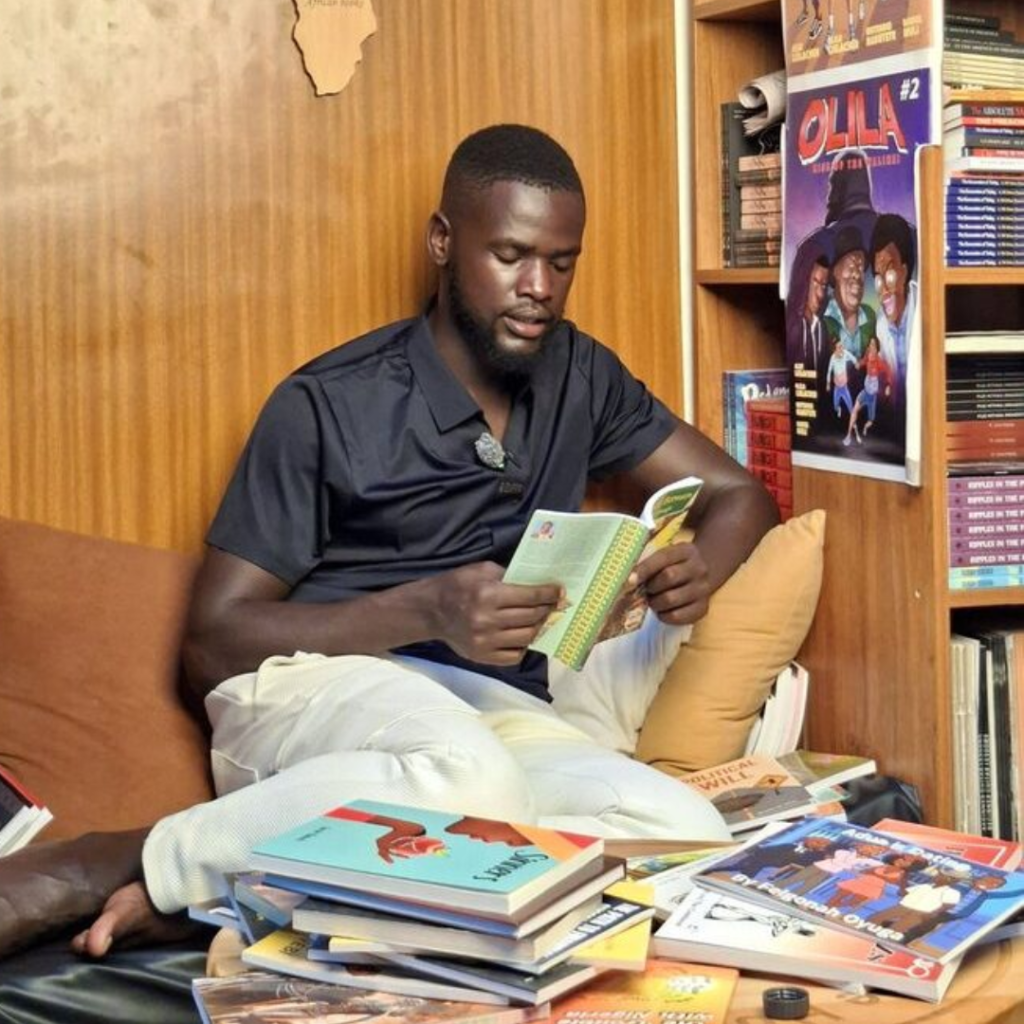

Kenyan author Emmanuel Muchui stunned many after completing a 73-hour reading marathon to revive Kenya’s fading reading culture.
Kenyan author Emmanuel Muchui recently captured national attention after launching an ambitious reading marathon at Nuria Book Store in Nairobi, an event meant to spark conversation about Kenya’s fading reading culture. The challenge wasn’t about chasing celebrity status or breaking some flashy Guinness World Record. Instead, it was about reminding Kenyans that books still matter.
A Marathon Built on Pages, Not Hype
Muchui kicked off the reading challenge at exactly 10:51 a.m., determined to stay immersed in books for more than three days. According to reports, he was allowed short breaks totaling just one hour and fifteen minutes across the entire marathon. That means most of his time was spent reading, battling exhaustion, and trying to stay mentally sharp.
What makes the story particularly fascinating is that he openly admitted this wasn’t about beating the global record set by Nigerian reader Samson Ajao, who reportedly managed 215 hours. Muchui’s target was simpler but arguably more meaningful: get Kenyans talking about reading again. Still, moments after finishing, 17 books later, he couldn’t resist a grin: “Next time, we break the world record.”
The message resonated with lots of people across Kenya, who all agree that there is a serious lack of interest in reading within their country.
Kenya’s Reading Culture
A recent report on Kenya’s changing reading habits showed that digital distractions are slowly replacing deep reading. Social media, short videos, and fast entertainment are winning the attention war. Newspaper readership has also dropped sharply in recent years as more people consume bite-sized content online instead of long-form material.

Now, this isn’t just a Kenyan problem; all over the world, our attention spans are shortening, and our attention is grabbed more by the newest dance craze than the bestsellers’ shelf. But in Kenya, people like Emmanuel are starting to notice. And they want to make a change.

Recent research in Kenya highlighted in the report found that many learners are progressing through school without strong reading comprehension skills. In some cases, Grade Four pupils reportedly struggled to understand Grade Three-level English stories.
That’s why Muchui’s challenge became bigger than one man sitting with books for 73 hours. It symbolized resistance against a culture increasingly addicted to speed, scrolling, and shortened attention spans.
Kenya Still Loves Stories
But as much as the research is concerning, it’s not the full picture. Stories aren’t dead. There’s another side to the conversation.

There’s been a lot of debate online about Kenya’s reading culture, and there’s a decent chunk of people who still firmly believe that Kenyans still love reading, but who argue that it’s just no longer restricted to traditional methods.
On Reddit, dozens of Kenyan readers recently shared the books they’re obsessed with, from classic literature to thrillers, African memoirs, fantasy novels, and philosophy. Some talked about reading on buses, others discussed audiobooks, while many admitted they now consume more digital reading than physical books.

One user even argued that Kenyans are actually reading more than ever; it’s just that the reading now happens on Substack newsletters, long X threads, blogs, and online forums instead of paperbacks.
Which does make a lot of sense.
Today’s generation reads captions, comments, tweets, newsletters, PDFs, articles, and chat messages constantly. The real issue may not be whether people read, but whether they still engage in deep, focused reading that builds concentration, imagination, and critical thinking. And that’s where books tend to have an advantage.
Why Reading Is Important
Reading, as in traditional, from-the-book reading, forces people to slow down. Unlike social media, reading a book helps us to develop patience. They expose us to ideas outside of our own algorithms.

That’s why educators and authors across Kenya have repeatedly raised concerns about declining reading habits. Several literary figures have warned that the country risks becoming a society that only reads for exams rather than for growth, curiosity, or creativity.
That’s what Emmanuel Muchui wanted to battle. By reading publicly for 73 hours, he transformed reading from a silent private activity into a national conversation.
He made people think. He made people debate whether people were reading enough, whether phones were a positive or negative impact, and whether Kenya needed to rebuild its reading culture.
Literary Spaces in Kenya
Muchui’s marathon took place at Nuria bookstore, a literary space that has earned an important place in the lives of Kenyan readers and writers. By hosting the marathon, Nuria also got the chance to draw attention to the importance and presence of literary spaces across Kenya.

Across Nairobi, especially, there are independent bookstores, book clubs, poetry spaces, and even online literary communities that are single-handedly keeping the country’s reading culture alive. By highlighting their existence in a public stunt like this, Muchui and Nuria got the chance to remind the public that they exist. That there are plenty of places to read, to find books, to talk about them.


Millie Ramm
Millie has been writing since she was a child, and has spent more time with her nose in books than anywhere else. She has been ghostwriting novels and editing for the past few years, and when not working she is curled up with her cats, looking for her next read.