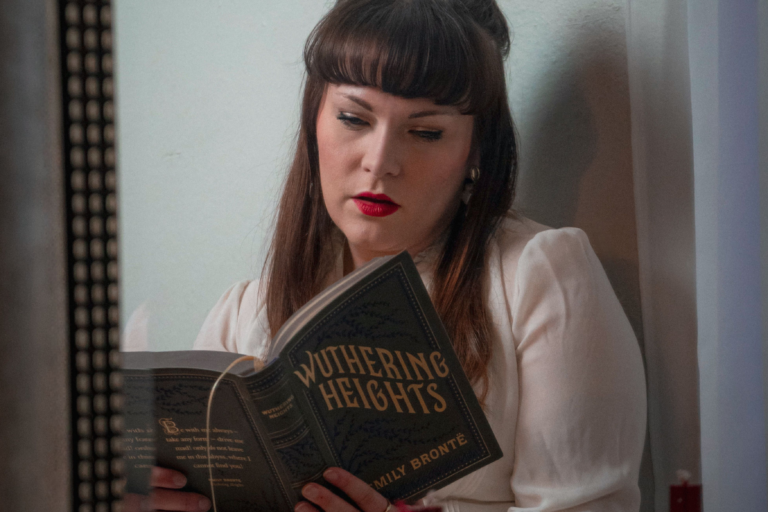

From Cambridge to Chelsea to Southampton, readers are discovering that the slowest way to move ten thousand books is also the best one.
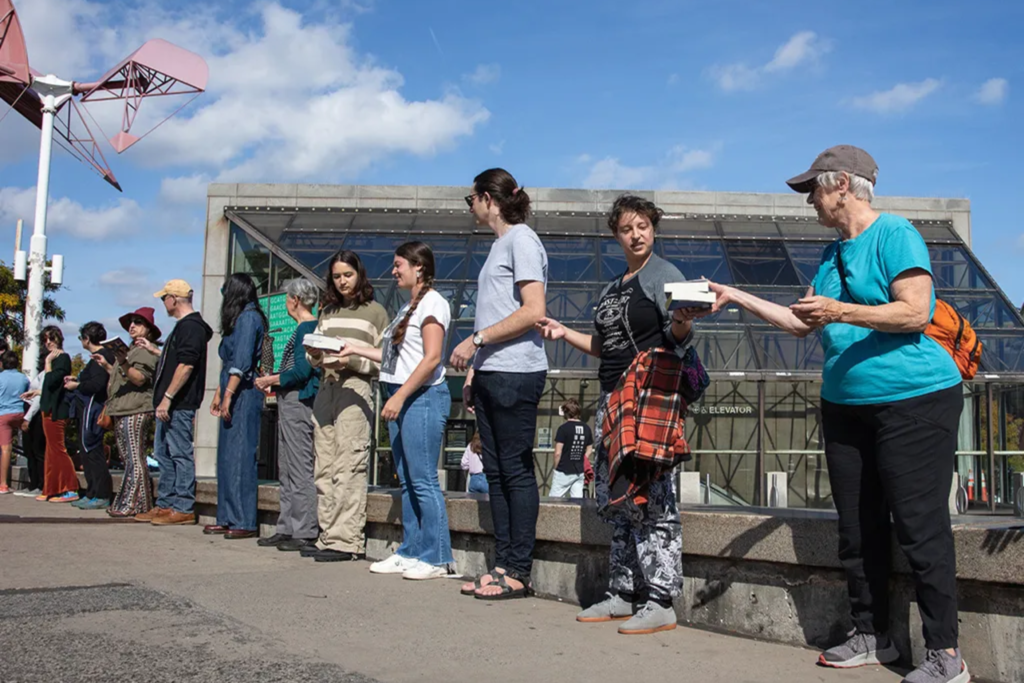
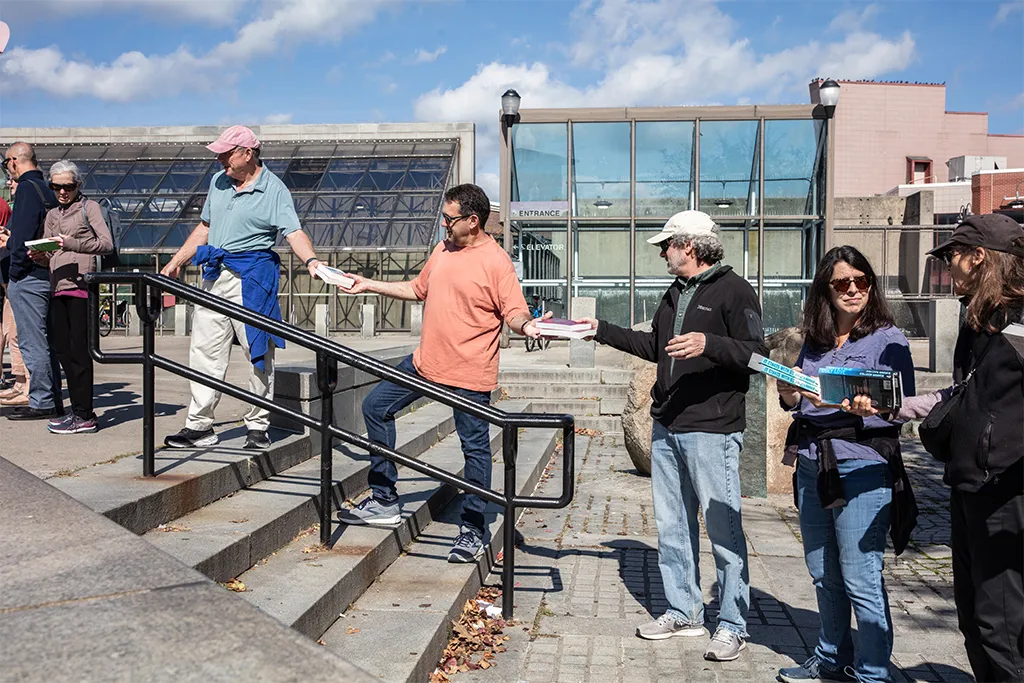
At one o’clock on Sunday, 6 October 2024, the Honk! The parade finished blaring its way through Porter Square in Cambridge, Massachusetts, bound for Oktoberfest in Harvard Square. As the brass faded, something quieter took its place on the same pavement. A line of three hundred people began to form, running from a shopfront at 25 White Street and across a shopping-plaza parking lot. They crossed Somerville Avenue, passed the entrance to the Red Line, and continued through the doors of an Art Deco building a thousand feet away.
They were not marching. They were moving a bookshop, one book at a time.
A Thousand Feet, Three Hundred Pairs of Hands
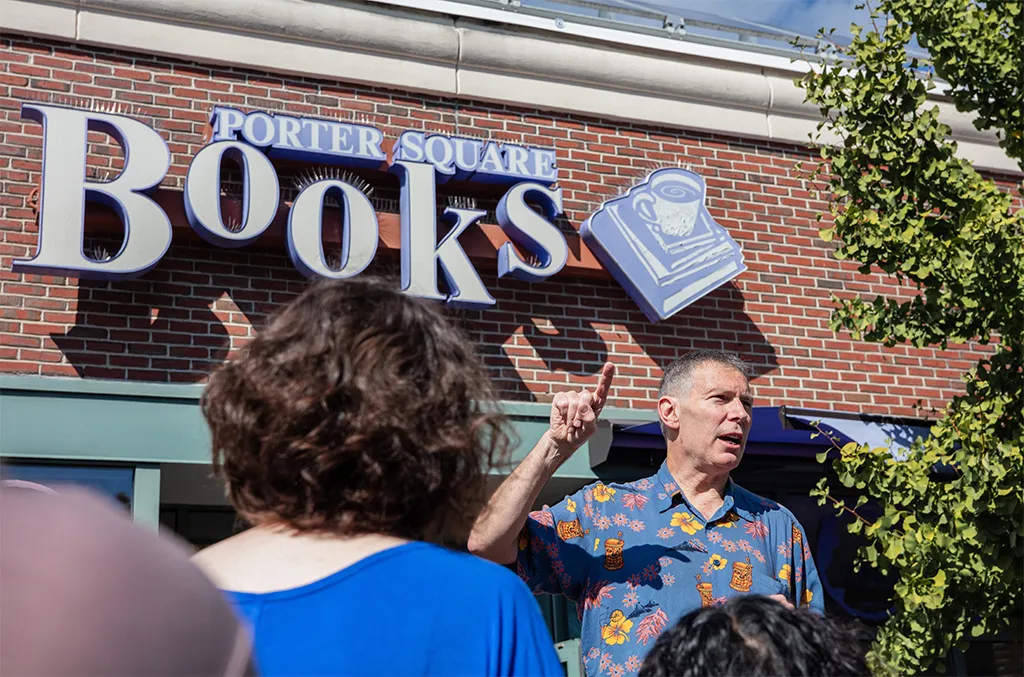
Porter Square Books turned twenty that September and left the plaza where it had spent its entire life for a larger home inside Lesley University’s University Hall at 1815 Massachusetts Avenue. Co-owner David Sandberg stood on a chair to brief the crowd. He told them essentially to spread themselves out along the route, cheerfully took no questions, and set the thing in motion.
The store had asked people to RSVP and estimated it needed about a hundred volunteers. More than three hundred came. Inside, a small group of four fed books into the line; among them, a neighbor who had been walking to Target saw the crowd and abandoned her errand to join. Outside, the chain settled into a rhythm of jokes and intermittent stretching. “We are the bookstore,” one regular said, which is either a boast or a job description, depending on how you read it.
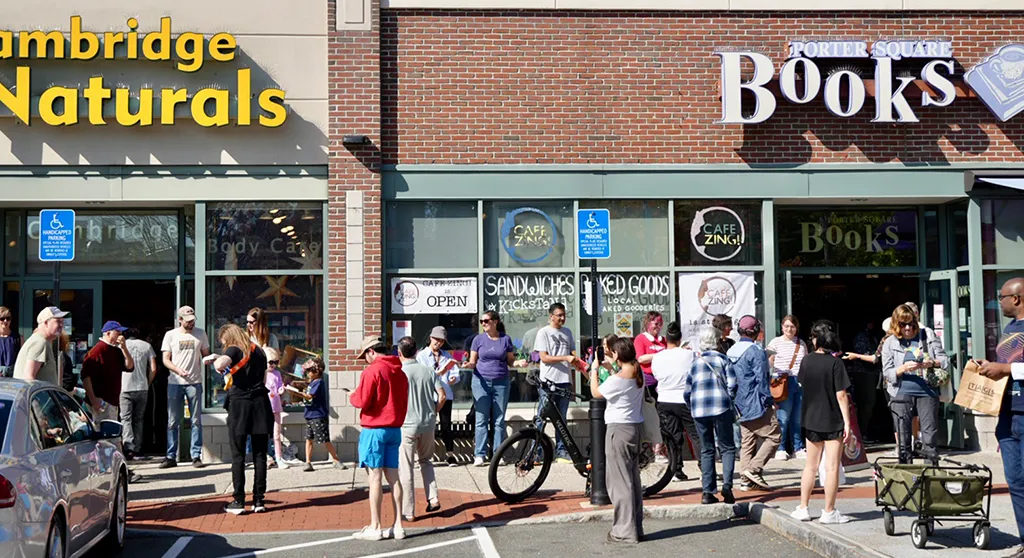
The most Cambridge detail of the whole day was the crosswalk. Rather than close a public road, staff stationed carts on both sides of the Somerville Avenue signal. While the light held pedestrians back, they loaded one cart from the chain. When the walk sign came, they wheeled it across and sent an empty cart back the other way, a piece of choreography planned in advance by the staff. Nobody blocked traffic. Nobody jumped a queue. The chain simply obeyed the city’s rhythm, and the city made room for it.
It took a little under an hour. At the end, Sandberg told volunteers to help themselves to the store’s advance reader copies and pick out something they liked. A regular moving service came on the Tuesday for the rest of the stock, and the new shop opened its doors that Thursday.
Why a Bookshop That Had Already Hired Movers Asked for Hands Anyway
That last fact unlocks the day. The professionals were coming anyway. Sunday’s chain carried the first load, a ceremonial stocking of the new shelves rather than a cost-saving measure, and everyone involved knew it.
Which raises the better question: why bother? Sandberg’s answer was plain. “They want to be a part of it,” he said of the store’s customers, and the chain was the way to let them. His colleague Josh Cook put the same thought more precisely. “People think of it as ‘my bookstore,'” Cook said, so an event like this validates that sense of ownership by letting people take part in the most hands-on way available.
Cook is entitled to use the word ownership in both senses. He is one of roughly ten longtime employees who, in 2018, became owners of half the shop alongside Sandberg and his wife. This makes Porter Square Books that rare thing: a neighborhood institution owned in part by the people behind its counter. The store opened in 2004, threw a twentieth-anniversary party in late September 2024, and opened a second location in Boston’s Seaport in 2021.
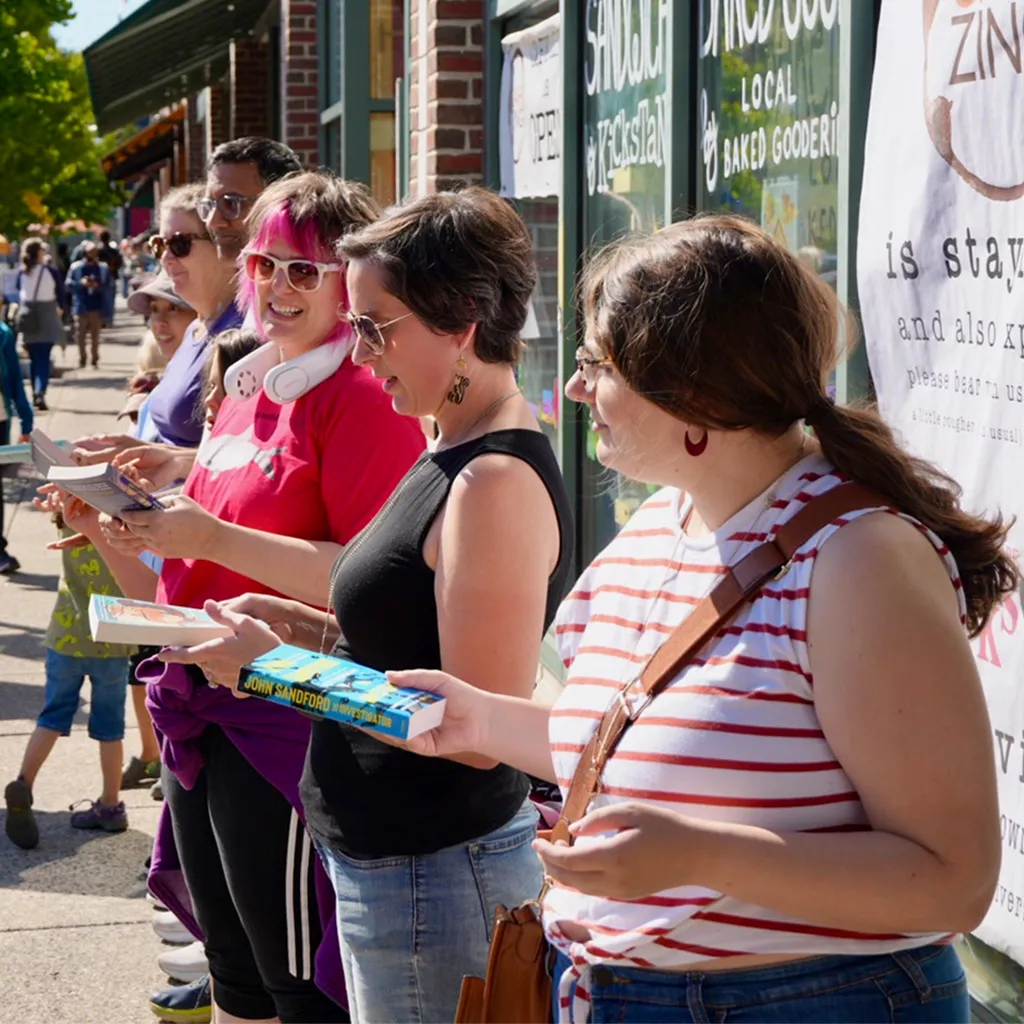
Then there is the building it moved into, which is quietly the best joke in the story. University Hall was a Sears department store from 1928 until the mid-1980s. Lesley University bought it in 1994. For a while it housed a Barnes & Noble, which closed long ago, and the storefronts Porter Square Books took over had most recently been a bank and a coffee chain. Into that space walked a worker-owned independent bookshop, about 40% larger than the one it left. It had café seating, two customer bathrooms, full accessibility, covered bike parking, and a landlord that wanted it there. “What better business than a bookstore for Lesley University?” the university’s communications director asked when the move was announced. The shop remains fully independent; only its landlord changed.
Other Bookshops Have Done It Too
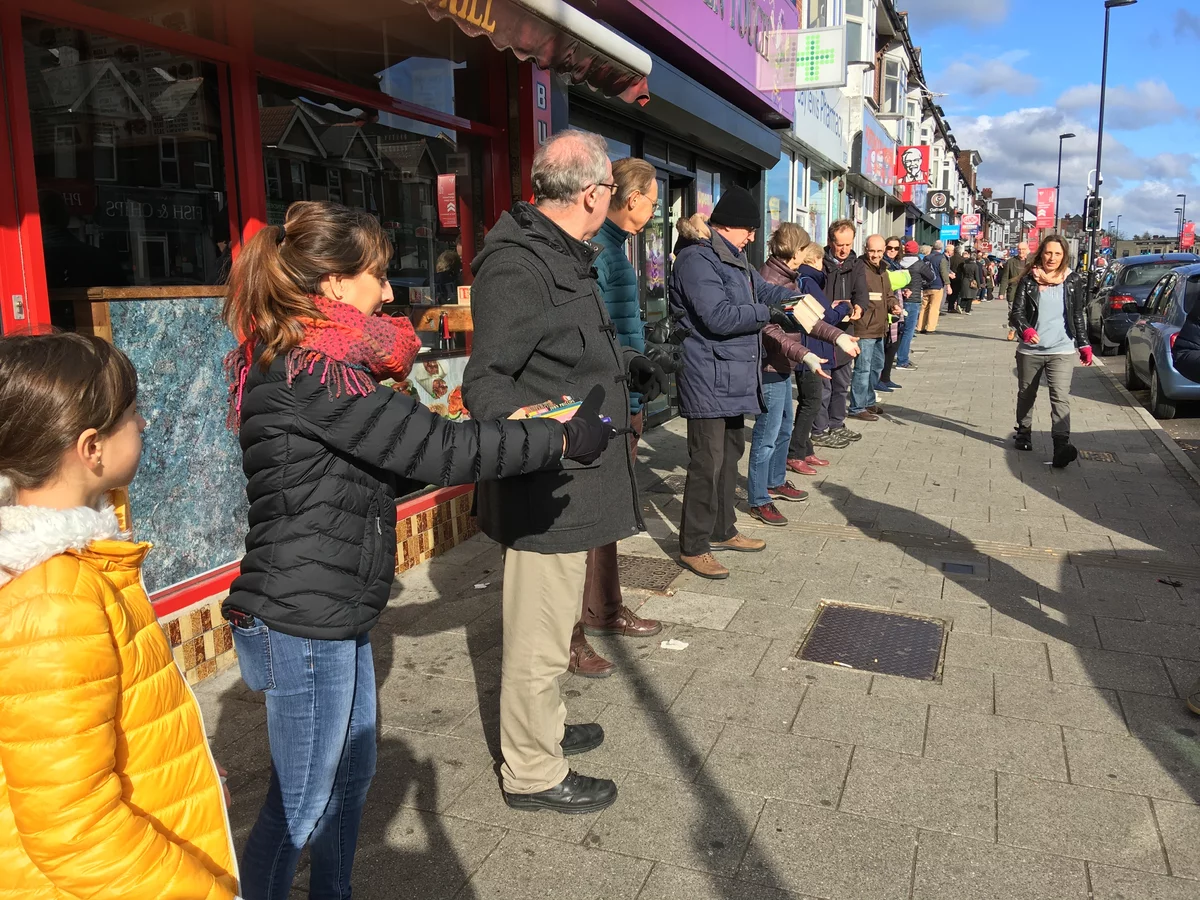
Other bookshops have moved in this way, and Cambridge was in good company. In late October 2018, October Books in Southampton, England, a not-for-profit co-operative with four decades of history, faced a rent rise and bought a former bank building 150 meters along Portswood Road. It then asked for help shifting the stock. Around 250 people came, cafés brought out tea, and passers-by joined the line as they realized what was happening. “We had elderly people, children, and everybody in between,” one of the booksellers said.
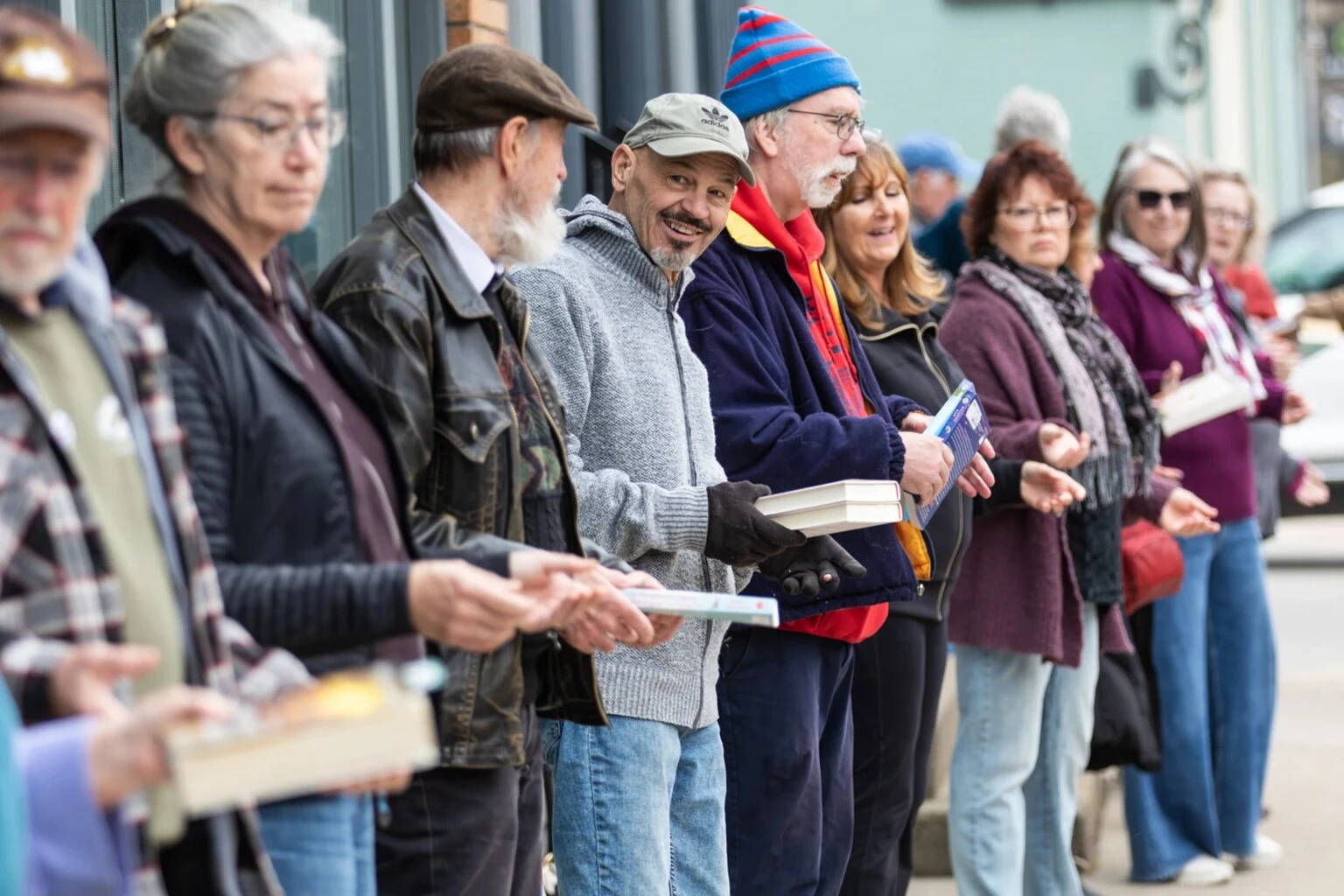
Six months after Cambridge, the idea surfaced in Chelsea, Michigan, where roughly 300 volunteers passed all 9,100 of Serendipity Books’ titles around the corner in under two hours and reshelved them alphabetically on the way. In July 2025, it reached Melbourne, where about 300 people stood in the winter rain to carry Hill of Content 120 meters up Bourke Street after 103 years at one address. Libraries have long done it too, from 650 volunteers passing folktales to a new central library in Norman, Oklahoma. In July 2026, a “Bookworm Relay” in Boonville, Missouri, saw hundreds of people form a human chain to move books to a new location, an idea a board member said she had copied from a preschool.
The Slow Way Turns Out to Be the Fast Way
Passing books hand to hand sounds like the least efficient method imaginable. Cambridge’s chain proves otherwise: it asked for three hundred volunteers. The first load was shelved in under an hour, a thousand feet crossed without closing a single road, and the new shop open for business by Thursday.
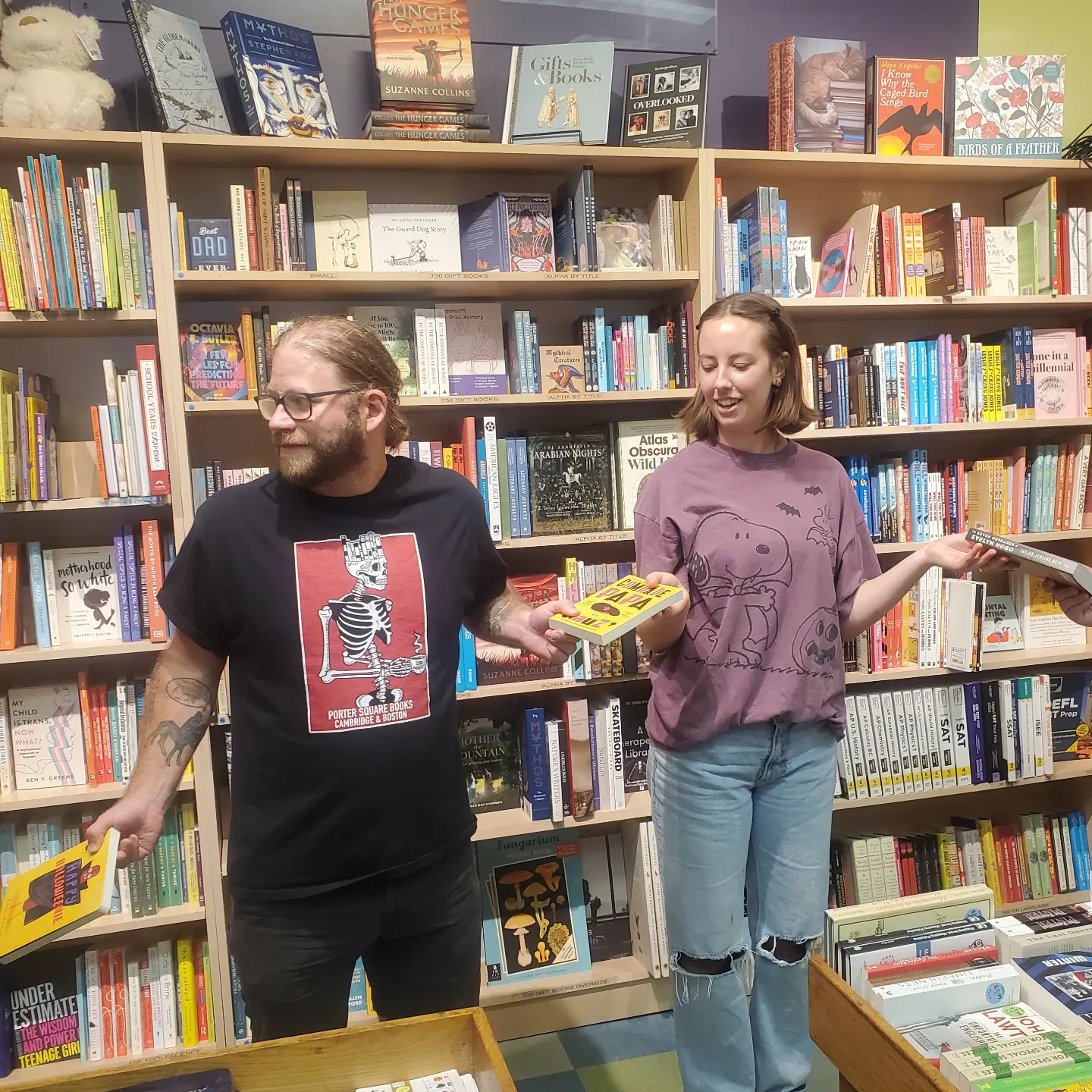
The deeper efficiency is harder to invoice. A book that travels through three hundred hands acquires three hundred small witnesses. Somebody says, “Oh, I loved this one.” Somebody writes down a title. Strangers spend an hour outdoors together holding other people’s stories very carefully. It is the opposite of one-click convenience, and it is not nostalgia. It shows what a bookshop actually is, which is never just the inventory.
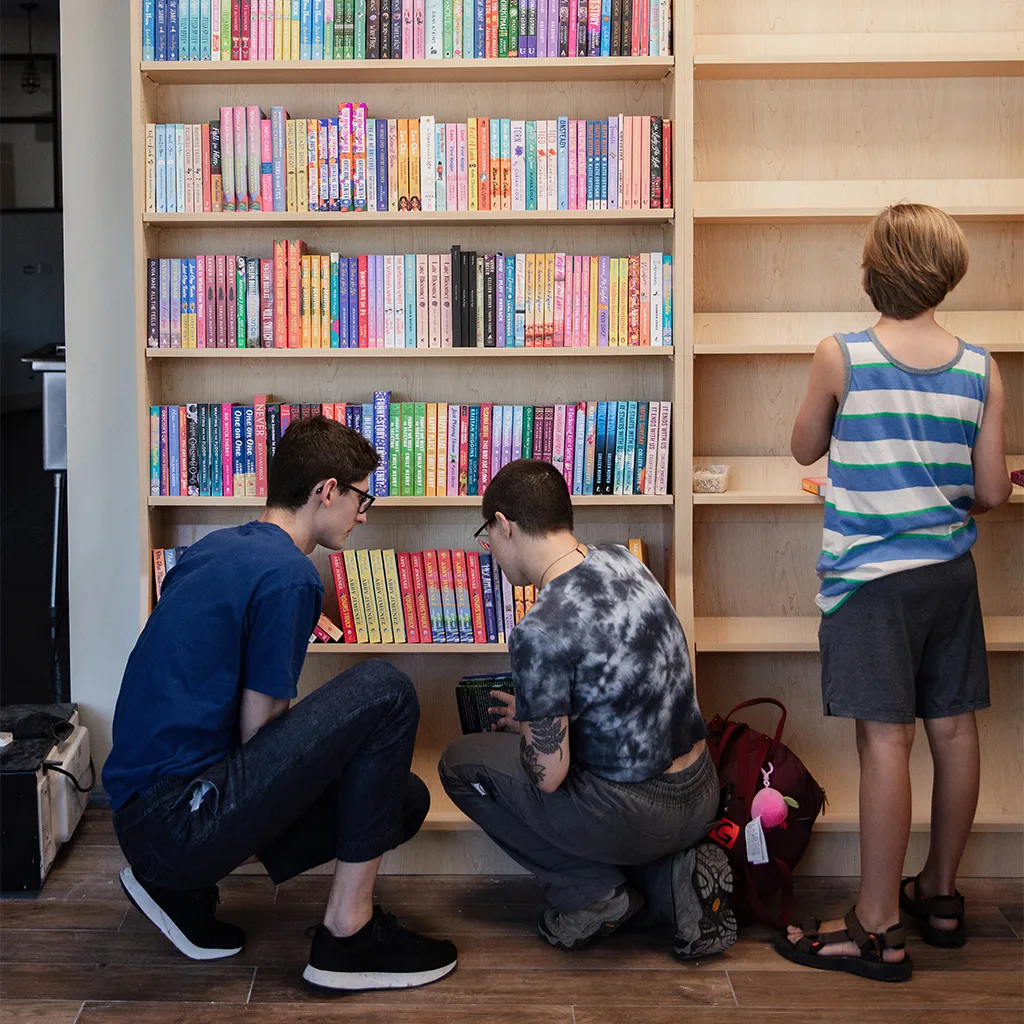
The trend line agrees. Booksellers counted 605 new independent bookstores that opened across the United States in 2025, with trade membership rising by 19% and a fifth consecutive year of more than 200 openings. Only 65 closed. Harvard Business School’s Ryan Raffaelli, who has studied the sector’s turnaround for years, calls it a story of hope and, above all, a story about community.


Adam Ryan
Adam is a distinguished content writer, bookworm, and full-time adventurer with a constant craving for coffee. When he's not working, he loves exploring remote corners of the world, immersing himself in different cultures, and writing about his experiences.